There’s a reason why change can be scary.
It’s a movement from comfort to possible discomfort, from the usual to the unknown. So most of the time, at least based on my experience, we stick to what’s safe and to what we know for sure. Which means, we do a lot of looking back.
And when we do, we notice another reason for why we avoid change: the cost.
I recently had a conversation with my friend Ymara about crossing things out.
It takes a lot of patience, courage, and a ton of self-awareness to try something new, be it a job, an investment, a relationship, only to one day decide that you don’t want that anymore. So you cross it off your list of the things you could do for the long haul. But again, we notice the price of change.
When we look back at the costs that took us to get to where we are now, we see lot of time and energy already spent and already used up. The money we poured on an investment to get to the current rate at which it’s earning, the energy it took to build a skill to get to the present level of performance at a certain field, or the time it took to build relationships with the people around us, they all point to the same thing:
something we can’t take back anymore, something we can only hold on to or risk losing.
Today, I listened to a podcast by Seth Godin on sunk costs and it brought me back to that conversation on crossing things out.
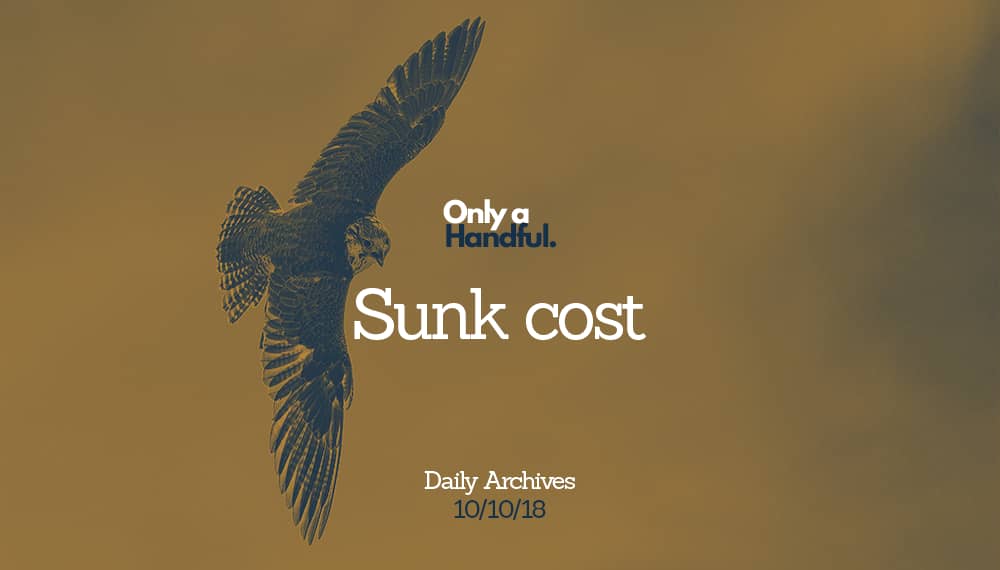
Really, what we were talking about were sunk costs. In business, sunk costs (shoutout to Investopedia) are costs that have already been incurred and cannot be recovered. “These are excluded from future business decisions because the cost will be the same regardless of the outcome of a decision.”
The same goes for the business of life.
What we have at the present moment, as Seth would put it, is a gift from our past self.
And the costs that we took to get here are gone; there is only this gift now. Whatever we choose to do, whether it’s staying at a job or leaving to pursue something else, the cost remains the same. But our emotions get in the way, and fear gets in the way, and the cost of change becomes gravely overestimated.
I guess the lesson here is to live forward, as it is the only direction at which life moves.
So that we may begin making decisions not because we fear to lose what we cannot take back in the first place, but because we are brave enough to.